Customizing
Everything can be customized through the Everything.ini, registry and Everything options.
This guide will help you customize Everything.
Window Caption
To customize the Everything search window caption, HTTP server title and/or taskbar notification title:
Example formats:
| Format | Search | Title |
|---|
| $s?{$s - }My Search | apples | apples - My Search |
| $s?{$s - }My Search | | My Search |
Note: Changing the window_title_format will also affect the title on the taskbar button.
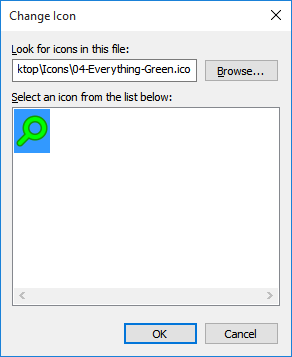
Icon
To change the Everything icon:
Download the colorful Everything Icon Pack:
Everything-Icons.zip
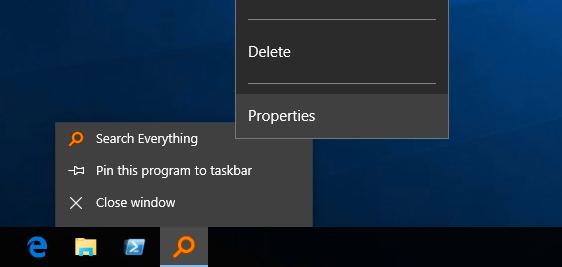
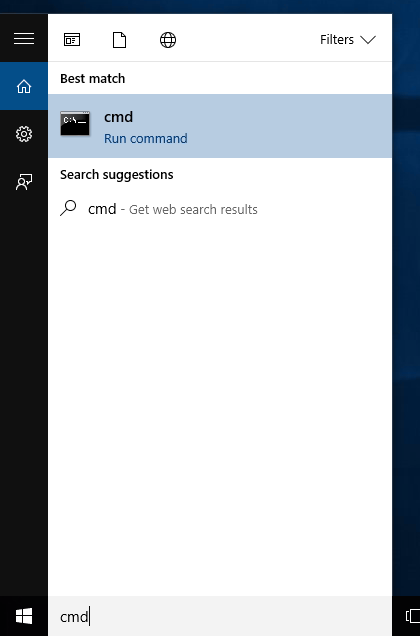
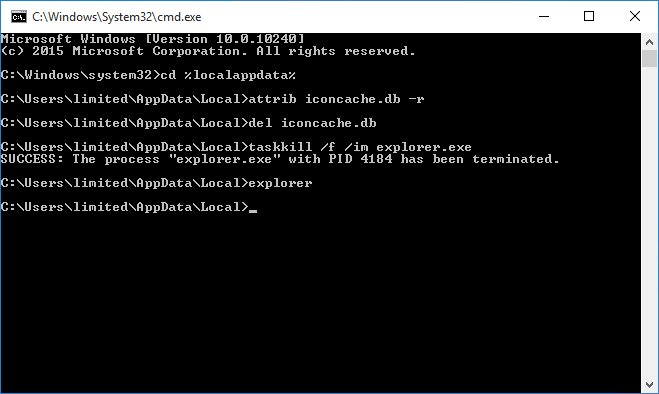
Taskbar Group Icon
To change the Everything Taskbar group icon:
External File Manager
To open paths in an external file manager:
To use a custom date format in Everything:
- Exit Everything.
- Open your Everything.ini.
- Change the following line:
Date format can be zero or more of the following codes:
| code | Description |
|---|
| d | Day of month as digits with no leading zero for single-digit days. |
| dd | Day of month as digits with leading zero for single-digit days. |
| ddd | Day of week as a three-letter abbreviation. The function uses the LOCALE_SABBREVDAYNAME value associated with the specified locale. |
| dddd | Day of week as its full name. The function uses the LOCALE_SDAYNAME value associated with the specified locale. |
| M | Month as digits with no leading zero for single-digit months. |
| MM | Month as digits with leading zero for single-digit months. |
| MMM | Month as a three-letter abbreviation. The function uses the LOCALE_SABBREVMONTHNAME value associated with the specified locale. |
| MMMM | Month as its full name. The function uses the LOCALE_SMONTHNAME value associated with the specified locale. |
| y | Year as last two digits, but with no leading zero for years less than 10. |
| yy | Year as last two digits, but with leading zero for years less than 10. |
| yyyy | Year represented by full four digits. |
| gg | Period/era string. The function uses the CAL_SERASTRING value associated with the specified locale. This element is ignored if the date to be formatted does not have an associated era or period string. |
- Save changes to the Everything.ini
- Restart Everything.
To use a custom time format in Everything:
- Exit Everything.
- Open your Everything.ini.
- Change the following line:
Time format can be zero or more of the following codes:
| Code | Description |
|---|
| h | Hours with no leading zero for single-digit hours; 12-hour clock. |
| hh | Hours with leading zero for single-digit hours; 12-hour clock. |
| H | Hours with no leading zero for single-digit hours; 24-hour clock. |
| HH | Hours with leading zero for single-digit hours; 24-hour clock. |
| m | Minutes with no leading zero for single-digit minutes. |
| mm | Minutes with leading zero for single-digit minutes. |
| s | Seconds with no leading zero for single-digit seconds. |
| ss | Seconds with leading zero for single-digit seconds. |
| t | One character time-marker string, such as A or P. |
| tt | Multicharacter time-marker string, such as AM or PM. |
| SSS | Milliseconds with leading zeros, must be the last part of the format. |
- Save changes to the Everything.ini
- Restart Everything.
Translucent Selection Rectangle
To change the translucency see
translucent_selection_rectangle_alpha
To change the background color see
translucent_selection_rectangle_background_color
To change the border color see
translucent_selection_rectangle_border_color
Change the default search and search settings
See
home
Fonts and colors
To change the result list font see
Fonts and colors
To change the search edit font see
search_edit_font_size and
search_edit_font_size
To change the status bar font see
status_bar_font and
status_bar_font_size
To change the result list header font see
header_font and
header_font_size
To change the status bar format see
statusbar_selected_item_format
HTTP Server
See
Change the default HTTP files.
ETP/FTP Welcome Message
See
etp_server_welcome_message in the Everything.ini.
See Also